St. John Paul II, St. Maximilian Kolbe, & the Blessed Mother – Video
In this brief video by Sherwood Fellows the key themes of Lent are explored - th...
 Dr. Italy

In this brief video by Sherwood Fellows the key themes of Lent are explored - th...
In this 8 minute video, Marcellino D’Ambrosio, Ph.D. (Dr. Italy) shares so...
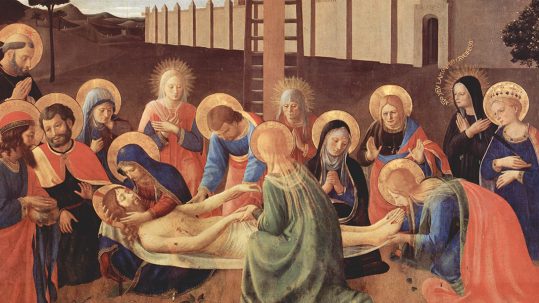
Bernard of Clairvaux on the martyrdom of the Virgin Mary at the foot of the cross – her heart is pierced by a sword as Simeon predicted. For the Fea...
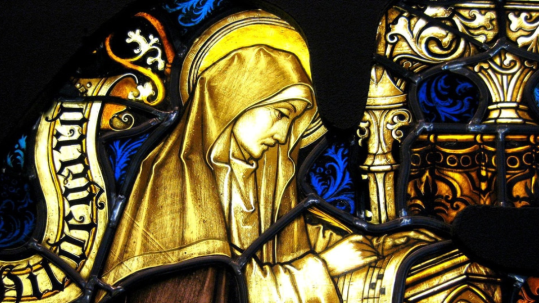
In this 14 minute podcast, Dr. Italy discusses the inspiring life of the great friend of St. Francis of Assisi, St. Claire. Her name means light or c...
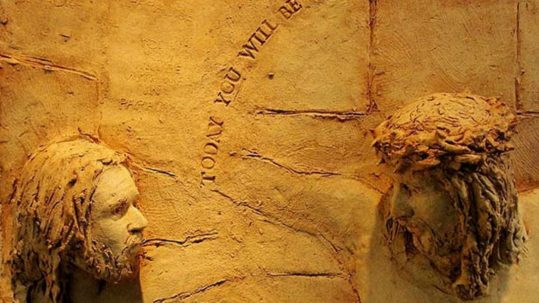
The parable of the workers in the vineyard is a shock to our sensibilities - some laborers work longer than others but at the end of the day, all get ...


This post is also available in: Spanish, Italian
Trinity Sunday celebrates the Church’s faith in the triune God, one God in three persons. This doctrine has baffled people for 2,000 years. Given that it is so hard to accept, why bother with it? What difference does the trinitarian dogma really make to how we live our Christian lives? To listen to this post read by the author, click the play icon below.
Many are ready to give a polite nod of some sort to Jesus of Nazareth. Most honor him as a great moral teacher. Many even confess him as Savior. But the Incarnation of the Eternal God? Second person of the Holy Trinity? God can’t be one and three at the same time. Such a notion is at worst illogical, at best meaningless. “This Trinity business was invented by the pagan Roman Emperor Constantine in 313 AD,” scoff a motley crew ranging from the Jehovah’s Witnesses to the Da Vinci Code.

Of course this charge has no historical leg to stand on. St. Ignatius of Antioch wrote seven brief letters around 110 AD in which he called Jesus “God” 16 times, beating Constantine by over two centuries.
True, the word “trinity” is not in the bible. But everywhere the New Testament refers to three distinct persons who seem to be equally divine, yet one (e.g. 2 Cor 13:13). So over 100 years before Constantine, a Christian writer named Tertullian coined the term “Trinity” as a handy way to refer to this reality of three distinct, equal persons in one God. It stuck.
But if the doctrine of the Trinity is authentically biblical, is it relevant? Does it really matter?
If Christianity were simply a religion of keeping the law, the inner life of the lawgiver would not matter. But if Christianity is about personal relationship with God, then who God really is matters totally. Common sense tells us that some supreme being made the universe and that we owe Him homage. But that the creator is a trinity of persons who invites us to intimate friendship with Himself — this we never could have guessed! We only know it because God has revealed it.
God is love, says 1 John 4:8 (see too John 3:16). If God were solitary, how could he have been love before he created the world? Who would there have been to love? Jesus reveals a God who is eternally a community of three persons pouring themselves out in love for one another. The Father does not create the Son and then, with the Son, create the Spirit. No, the Father eternally generates the Son. And with and through the Son, this Father eternally “breathes” the Spirit as a sort of personalized sigh of love. “As it was in the beginning, is now and ever shall be.” That’s what the conclusion of the Glory Be really means, that the self-giving of the three divine persons did not begin at a moment in time, but was, is, and is to come.
If we are truly to “know” our God, we must know this. But if we are ever to understand ourselves, we must also know this. For we were made in the image and likeness of God, and God is a community of self-donating love. That means that we can never be happy isolated from others, protecting ourselves from others, holding ourselves back selfishly from others. Unless we give ourselves in love, we can never be fully human. And unless we participate in the life of God’s people, we can never be truly Christian either. Because Christianity is about building up the community of divine love which is called the Church. If God is Trinity, then there really is no place for free-lance, lone-ranger Christians.
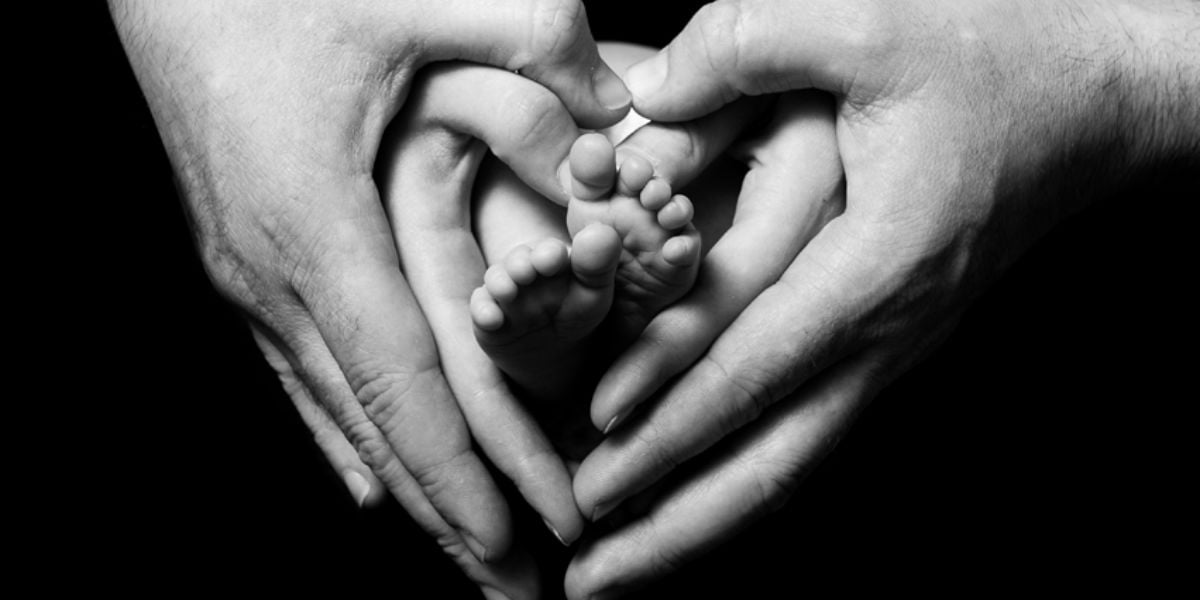
The family, the domestic Church, is a reflection of trinitarian love – the love of husband and wife, distinct and very different persons, generates the child who is from them but is nonetheless distinct from them, indeed absolutely unique.
And that is the final point. One of the greatest treasures of Western culture is the concept of the uniqueness and dignity of the individual person. You really don’t find this idea in the ancient societies of Greece and Rome or in other great world religions, such as Islam.
The concept of the irreplaceable uniqueness of each person came into Western culture straight from the doctrine of the Trinity, three who possess the exact same divine nature but who are yet irreplaceably unique in their personhood.
The irony? As it progressively abandons the triune God, the Western world is undermining the very foundation of personal dignity, individuality, and freedom that it values so much.
So yes, the Trinity does matter.
For more on this topic, listen to Dr. Italy’s Podcast WHY THE TRINITY MATTERS.
For a brief meditation from St. Catherine of Siena on the triune God, read TRINITY DEEP MYSTERY.
For more on the Triune God, see the TRINITY SECTION of the Crossroads Initiative Library
This essay on the Church’s trinitarian faith in the triune God, one God yet three persons, is offered as a reflection on the scripture readings for Trinity Sunday (Exodus 34:4b-9; 2 Corinthians 13:11-13; John 3:16-18). Trinity Sunday is observed annually the Sunday following Pentecost.


From a colorful and varied background as a professor of theology, a father of five, business owner, and professional performer Marcellino D’Ambrosio (aka “Dr. Italy”) crafts talks, blog posts, books, and videos that are always fascinating, practical, and easy to understand. He is a popular speaker, TV and radio personality, New York Times best-selling author, and pilgrimage host who has been leading people on a journey of discovery for over thirty years. For a fuller bio and video, visit the Dr. Italy page. For a full Curriculum Vitae (CV) of Dr. Italy, click here. 



prolifemama
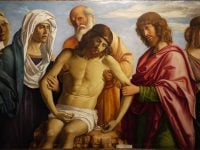
Posted at 12:36h, 18 MayO little precious innocent one pictured at the top of this article… eyes closed in peaceful slumber, lips wet with your last suck of milk still between them…
may we olders accept nourishment from our Father with just the same trust, abandoning ourselves to Him in sleep, and know again that He continually gives us in complete Love, everything we need!
IAmBrianBoru
Posted at 15:11h, 18 MayThat is the best explanation of the Blessed Trinity I have read, to date! I have been intrigued by the idea of a trinity of persons united in one being for quite a long time.
I write a weekly insert for our parish bulletin and only wish I could have explained it as clearly and succinctly as you have.
Thank you for posting this!
Marcellino D'Ambrosio
Posted at 00:14h, 26 MayIAmBrianBoru, thanks for the words of encouragement. You have our permission to share this article and other articles from the Crossroads Initiative site in your parish bulletin!!! We’d just ask that you put the URL of the site in the insert so people can also visit the website directly for more info about our faith. Also, we’d encourage you to put a link to the site on your parish website if you have one! God bless!
Tom Starr
Posted at 17:13h, 30 JanuaryRegarding the statement that the concept of the Holy Trinity had to be revealed and could not have been discovered otherwise, I believe we can actually get quite far using our God-given reason. Like any mystery, of course, we can’t get a complete understanding. Frank Sheed in “Theology for Beginners” reasoned it this way: God’s most basic activity is knowing, and the first thing He knows is Himself. Since He is infinite (He has no limits), His knowledge of Himself must also be infinite, and yet we cannot have two different infinite things, since one would have something the other doesn’t, and so one wouldn’t be infinite. So we have (1) God, and (2) God’s knowledge of Himself which are obviously not the same thing, and yet because they are both infinite, they are the same thing, or as we say, they have the same nature. We call one the Father, and the other the Word (knowledge), or the Son. Likewise, the relationship between the Father and the Son must be Love. Could this love be limited? No, it is also infinite. Therefore, it is a separate thing, the Holy Spirit, and shares the same nature with the Father and the Son. This is certainly not a complete explanation, but it has helped me with my understanding, and confirms the use of reason. I hope this helps others. BTW, any of Frank Sheed’s books are highly recommended. Fr. Richard Rohr’s book, “The Divine Dance”, also provides interesting insights.
Steven Braatz
Posted at 17:18h, 30 JanuaryWow! This is the most profound essay I have read in quite a while. The family is an icon of the Trinity! That is amazing. And also the uniqueness and dignity of the human person emanating from the trinity. Thank you for these wonderful insights dr. D’Ambrosio
Marcellino D'Ambrosio
Posted at 17:18h, 30 JanuarySo glad that you have found this helpful, Steven!
Marcello M.
Posted at 17:18h, 30 JanuaryIt’s very simplistic but I attempted to explain the Trinity to my young children this way. We all go through very distinct phases in our lives. We’re children, adults, and then old. Even though we’re very different types of people during these phases we’re all wrapped up into one person – You and Me. And that never changes. All those very distinct people; you as a child, an adult, and an elderly person; eternally resides within each one of us only to be revealed at the appropriate time.