St. John Paul II, St. Maximilian Kolbe, & the Blessed Mother – Video
In this brief video by Sherwood Fellows the key themes of Lent are explored - th...
 Dr. Italy
In this brief video by Sherwood Fellows the key themes of Lent are explored - th...
In this 8 minute video, Marcellino D’Ambrosio, Ph.D. (Dr. Italy) shares so...
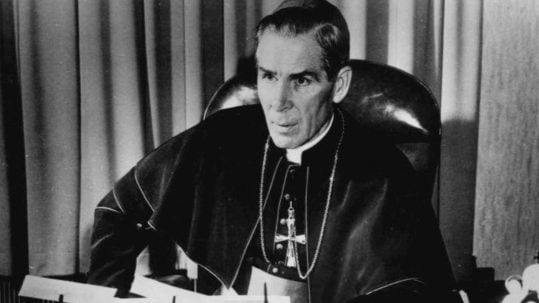
On February 3, 1994, Mother Teresa was invited to speak at the National Prayer Breakfast sponsored by the U.S. Senate and House of Representatives. P...
Timeline and biographical highlights of the great 20th century Capuchin Franciscan Saint, Padre Pio of Pietralcina whose feast day is September 23. C...
The parable of the two Sons makes clear that saying yes to Jesus Christ is much more a matter of deeds and actions than words and promises. Talk is c...


This post is also available in: Spanish, Italian
John the Baptist pointed out Jesus as the spotless Lamb of God who takes away the sins of the world. This title, so prominent in the Mass, illumines the meaning of Christ’s passion, recalling the first Passover remembered every year during Holy Week and the Triduum. For the second (2nd) Sunday in Ordinary Time, cycle A.
The Protestant Church is all about the Bible; the Catholic Church is all about the Sacraments. Right?
Not exactly. When it comes to personal Bible reading, Protestants often put Catholics to shame. But as far as Sunday worship goes, it is hard to find a more biblical service than the Mass. The readings are awesome enough, but even the prayers of the Mass are full of Scripture. Many lines spoken by priest and people are, in fact, direct quotes from the Bible. Consider, for example, what the priest says just before communion: “Behold the Lamb of God, who takes away the sins of the world.” That’s a direct quote from John 1:29 where John the Baptist says this as he points out Jesus to his disciples.
We are so used to calling Jesus the Lamb of God that we can miss the jolt that this must have given the first people who heard it.
Most Jews were expecting a Messiah who would be the Lion of Judah, a new David who would drive out the Romans through military heroism. It hadn’t occurred to them that the Messiah would be a Lamb.

Lambs are not exactly known for their prowess in battle. They don’t kill; they die. They were, in fact, sacrificed daily in the Jewish temple as an act of worship to God.
But there was a special sacrifice that happened every year in which lambs were featured most predominantly. It was the central celebration of the Jewish Year–Passover. This was the yearly remembrance of the greatest act of salvation in the Old Testament, the deliverance of the Jews from Egyptian slavery. The final plague that would bring Pharaoh to his knees and the Israelites to freedom was the angel of death “passing over” Egypt to take the lives of Egypt’s most precious resource–their first-born sons.
What was to prevent the Israelites from suffering the same fate? The sacrifice of a perfect lamb, without spot or blemish. This Lamb was a substitute for the first-born of the Israelite family that offered the sacrifice. And a costly offering this was, since the wealth of a family was counted in terms of its animals.
The blood of the Lamb was to be smeared on the doorpost of the house and the family was to eat the flesh of this sacrificial animal in a special ritual meal.
We all know the end of that story. Pharaoh let the Israelites go, and the Israelites celebrated this event each year, with hundreds of thousands of Jews coming to Jerusalem to sacrifice their lambs and to eat the Passover supper in the Holy City.
It was no accident that Jesus was arrested and put to death during Passover. In the Gospel of John, Jesus breathes his last at the very same moment that the Passover lambs were being sacrificed in the Temple. The same Gospel is the only one to point out that Jesus legs weren’t broken to make sure he was dead, as was customary in crucifixions. Rather, the Romans employed an alternate verification method – a lance thrust to the heart (John 19:32). Why does John take pains to emphasize this? Perhaps because Scripture stipulates that no bone of the Passover Lamb could be broken (Exodus 12:46).
All the words and events of the Old Covenant had great value, meaning and dignity in and of themselves. But they also pointed forward to a greater covenant, to a person who was the Word made flesh, to a Lamb who saved Israel from a deeper slavery than Pharaoh’s, to an event that would be the culminating moment in human history.
The Word came as a spotless Lamb to offer the perfect sacrifice of love that would outweigh all human evil and therefore take away all sins. The Shepherd offered his blood for our sins and gave his body as our new Passover meal. His aim? To give his sheep the strength to become lambs who offer their lives for the life of the world (Romans 12:1), just as he did.
This post focuses on John the Baptist pointing out Jesus as the Lamb of God. It is a reflection on the scripture reading for the second (2nd) Sunday in Ordinary Time, cycle A (Isaiah 49, Psalm 40, 1 Corinthians 1:1-3; John 1, 29-34) but also on the readings for Holy Week, particularly Holy Thursday and Good Friday.
For a 14 minute PODCAST related to this topic, listen to THE ORIGINAL BIBLE CHURCH.
For more on Jesus as the Lamb of God, see the JESUS SECTION of the Crossroads Initiative Library.
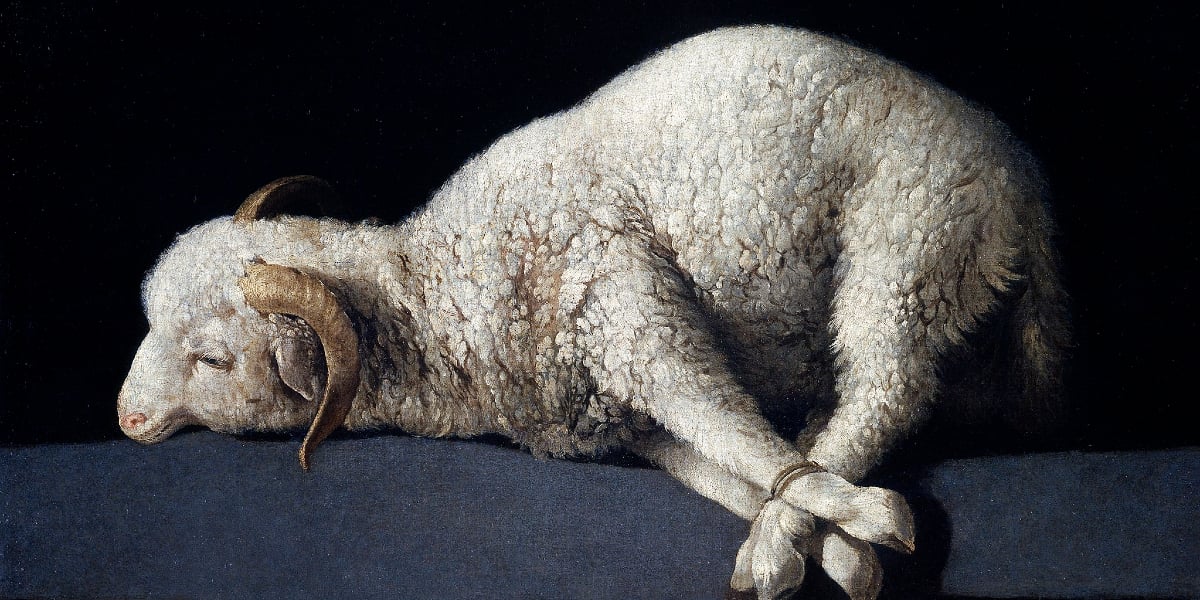
Banner/featured image Agnus Dei by Francisco Zurbaran ca. 1640. Public domain.


From a colorful and varied background as a professor of theology, a father of five, business owner, and professional performer Marcellino D’Ambrosio (aka “Dr. Italy”) crafts talks, blog posts, books, and videos that are always fascinating, practical, and easy to understand. He is a popular speaker, TV and radio personality, New York Times best-selling author, and pilgrimage host who has been leading people on a journey of discovery for over thirty years. For a fuller bio and video, visit the Dr. Italy page. For a full Curriculum Vitae (CV) of Dr. Italy, click here. 

Shelton D'Cruz
Posted at 17:18h, 30 JanuaryTo consummate the ultimate sacrifice, which is our Blessed Lord, we must eat the Lamb which is our Eucharist.
Dennis Gaynor
Posted at 20:15h, 13 JanuaryDr. Italy,
Your podcast about the Bible church referenced the “Assumption Bible”as good bible to use in order to read the Bible. But I cannot find it at the catholic store website. Can you help me find it?
Jacob Kempen
Posted at 08:28h, 14 JanuaryJesus offered the perfect sacrifice of love that would outweigh all human evil and therefore take away all sins. Sins are when a person goes against how God has commanded we should act toward him or our fellow men. Why was it necessary for Jesus to offer himself as a perfect sacrifice to God for God to forgive our sins. This is sort of a group forgiveness for all humanity for our sins. This seems to imply that sacrifice to God is required for sins to be forgiven. Jesus teaches us that a persons sins will be forgiven if that person asks for forgiveness and changes their ways to truly love and serve God. Why the need for the group forgiveness of Easter if we each have this path for individual forgiveness & reconsiliation?
Mary Lou Bartl
Posted at 16:01h, 14 JanuaryTo receive the body and blood of Jesus is the greatest gift God could ever give us. The culmination of the Mass and our faith.
Dr. Marcellino D'Ambrosio
Posted at 13:13h, 16 JanuaryThe Ascension Bible is the one I recommended – it is the Revised Standard Version, 2nd Catholic edition and is available from Ascension Press.
Dr. Marcellino D'Ambrosio
Posted at 13:16h, 16 JanuaryWe may be alone with God or alone with Christ and his priest in confession when we ask for forgiveness, but we are always saved and forgiven as members of the Body of Christ, the Church.